Barry Winders author of 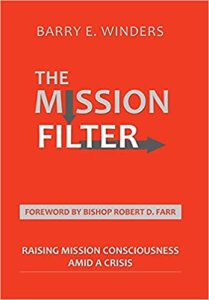 The Mission Filter: Raising Mission Consciousness Amid a Crisis says that the COVID-19 crisis is a hinge point for the church.
This pivotal time demands mission-focused leaders lest the church slip back into the busyness and non missional activities of the pre-COVID-19 past.
Over the past 25 years, almost half of my life I’ve been involved in church ministry in one form or another, from children & youth to worship ministry, small groups coordinator and just about everything in between.
Much has changed in that time, not just for me personally, but also within society as a whole, and especially in the church mission and ministry environment. In many ways if we are to look back at the past 25 years we will see that we have been part of a seismic shift that has been going on for quite a while.
Maybe, just maybe, we haven’t been able to identify this shift as clearly as we may have, because of the myriad of changes that have been going on simultaneously in and around us, or because we have been blind to what God is doing in and through us.
 Recently Joseph McAuley, pastor of St Luke’s in Tauranga, NZ posted on his facebook page* that;
The time of the contemporary mega-church as the exemplar and popular paradigmatic icon of the local church has come and gone. It will have its place but, in our nation of predominantly provincial cities and small towns, it’s not going to be the pot at the end of the rainbow so many pursue.
A new day is dawning, though it hasn’t yet arrived. We are currently in a liminal space, a wardrobe between two worlds, the dead ends of yesterday behind us and the newness of God’s tomorrow ahead. There are lamp posts pointing the way though, scattered here and there. Early adopters who looked out of place in the old paradigm but now appear to be perfectly positioned for the new. Prophetic voices who seemed nonsensical yesterday but today seem strangely in tune. Perhaps, in places, new realities can already be seen. Here and there, hints of the following…
 Size will no longer dominate the score card. Big or small will no longer be the yard stick of what a healthy church looks like. Bigger won’t automatically be better, and might even be undesirable.
Natural localised expressions of the church will bubble up. Churches will feel free to specialize in what comes most naturally to them – craft beer rather than mass produced lager. Each will have distinctive flavours that appeal to some but not so much to others, but the pressure to try and be all things to all people will evaporate. Pastors and congregants will be content to have strengths and weaknesses in terms of programs and options.
This will be complimented by a more ecumenical perspective of the Church. Church goers will no longer feel the need to justify or engage in confirmation bias in regard to their local church. It will simply be their local community. Appreciation of the beauty of other local churches and their contribution to the Body of Christ will develop. No longer tribal Christians will be able to enjoy the strengths of other churches, worship nights, youth ministries, community mission and various seminars or events. They’ll be complementary not the competition.
 They’ll be a renewed commitment to whole of life discipleship. Not a whole of life commitment to church meetings every night of the week, but also not discipleship compartmentalised to Sunday. The commitment will be to a whole of life discipleship that is engaged and attentive throughout the totality of one’s week, the totality of one’s life. A renewal of the disciplines.
The voice of the Spirit will be prioritised over other voices in one’s life. A deep commitment to tune into the whisper of God’s voice in one’s life will take over the agnosticism of one’s ordinary consciousness. Instead of one’s concern being what he said, she said, that article said, that Facebook post said, there will be a deep desire to discern the still and small voice of God in the moment. By default this will mean the silencing of other voices in our life, turning the volume down on social media, turning off the 24/7 noise of our phones, the conscious elimination of social commentary that overwhelms our being.
The pace of church will be that of a young family with kids. Slow-church will become one of the great invitations of the church in contrast to the fast-paced and high-tech world around us. Pastors and churches will engage in Christ-like ministry that meanders along at about 4.5 kms per hour. Not the speed of sound, not the speed of light, but the speed that Jesus walked throughout Judea and Galilee. Ministry at the speed of a Sunday stroll.
 None of this is new or unknown, but it is scattered and piecemeal, practices of the subversive rather than the centre. Perhaps though, they’ll move to centre and launch a reformation. Time will tell. They’ll be other characteristics too. No doubt.
* Used with permission.
The thing is, post-Covid ‘lockdowns‘ many church leaders are seeing a shift in the narrative, as they recognise that churches “need to get back to ‘our‘ mission!” We need to do a thorough assessment of our methodology and missiology so that we can work effectively towards achieving what it is that God has called us out to be.
It is not enough to be providing great worship services, and ministries to the gathered – that just exasperates the area of consumerism within the church, or even to provide aid to those that require it without looking at the whole person – that creates a level of dependance.
If we are to achieve our mission we need to ensure that all of our interactions are interlaced with an acknowledgement of Christ and how He has made what we do, available for others – It is not enough for someone to look at what we do and know!
In the case of The Salvation Army here in New Zealand in many people’s eyes it is known more for its Op Shops, Drug & Alcohol services and Community Ministries and charitable work than it is is anything else – Which makes the verse from Romans 10:14 quite pertinent;

“Before people can trust in the Lord for help, they must believe in him. And before they can believe in the Lord, they must hear about him. And for them to hear about the Lord, someone must tell them.” Romans 10:14 (International Children’s Bible)
So, may you become more mission-focussed in your interactions – for now is the time for mission-focused leaders!


 The life and times of Perry...