Feeds:
Posts
Comments

Posts Tagged ‘Andy Stanley’

A few weeks ago we started looking at the area of Mission and Ministry within the context of the Christian Church, exploring the question;

What Will Your Church Look Like Post-COVID-19?

Even though it could be argued that it will be many more years before we are truly Post-Covid, there is a recognition from many church leaders that after experiencing ‘Covid lockdowns‘ we are seeing a shift in the narrative.

They’ve come to recognise that churches and even some faith-based organisations “need to get back to ‘their‘ God-ordained mission!” That specific thing that God raised them up to be! 

They acknowledge that the “why they exist” is more indispensable now than ever before. And that they need to do a thorough assessment of their methodology and missiology so that they can work effectively towards achieving what it is that God has called them to be. Their true identity!

They recognise that there is “no turning back!” they can’t afford to return to the way things were before the crisis and that they need to “focus on the mission“.

Implementing a mission filter to ensure that all of their systems, programmes and processes, their ministries and services are directed towards fulfilling the overall mission, not just a part of it.

They’ve come to realise that now is the time for mission-focussed leaders that constantly point people to the ‘overall‘ mission, lest they slip back into the busyness and non missional activities of the pre-COVID-19 past. And they concede that fine tuning won’t fix the church, they need something much more substantial.

So how can we stay focussed on our mission when people, systems and processes within the broader ‘machine’ are constantly trying to draw us back into the busyness and non missional activities of our pre-COVID-19 past.

Barry Winders author of The Mission Filter: Raising Mission Consciousness Amid a Crisis posted an article on the Lewis Centre for Church Leadership site. In it he explains that we need to utilise “a mission filter question or statement that can consistently focus everyone’s attention and energy on where they are going and why.”
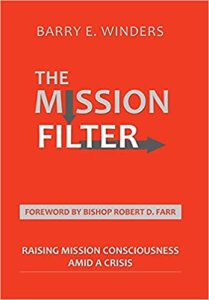
For a church or faith-based organization, a mission filter is a self-monitoring tool that gives leaders [at every level of the church / organisation] the ability to test their systems for engaging and serving people beyond their walls. It connects and brings clarity between mission, vision, and action steps.”

He has recognised that a mission statement is not enough – we need something that connects and brings clarity between the mission and vision, and the subsequent action plan steps we then make to achieve our goal of fulfilling the mission. If they are not succinctly connected we can create a multitude of ways of achieving a part of the mission, but not the overarching holistic mission.

Andy Stanley in his book 7 Practices of Effective Ministry also touches on this and if applied correctly, they should aid any church / faith based organisation to protect the organisation’s simplicity, move the people in one direction, focus environments of meetings and ministry, and effectively evaluate its activities.

Practice #1 – Clarify the Win: Define what is important at every level of the organization. This practice asks,“How do we measure success?”The four steps to clarifying the win: sum up the win in a simple phrase, keep the win as specific as possible, restate the win frequently and creatively, meet to clarify the win at every level.

Practice #2 – Think Steps, Not Programs: Before you start anything, make sure it takes you where you need to go. This is summed up in the following statement; “First, determine where you want people to be. Then figure out how you’re going to get them there. That’s doing ministry with the end in mind.” How to create an effective step? Make each step easy, obvious, and strategic.

Practice #3 – Narrow the Focus: Do fewer things in order to make a greater impact. Narrow the focus by simplifying, creating environments as distinctive brands, for increased relevance, better connection, higher quality, and stronger impact.

Practice #4 – Teach Less for More: Say only what you need to say to the people who need to hear it. Four steps to teach less for more: decide what you are going to say, decide to say one thing at a time, decide how you are going to say it, and say it over and over again.

Practice #5 – Listen to Outsiders: Focus on who you’re trying to reach, not who you’re trying to keep. Listening to outsiders is about listening to the lost to understand how to reach them.

Practice #6 – Replace Yourself: Learn to hand off what you do. Train up leaders, applaud those who applaud others, teach what you know, and hand it off. Three steps to handing it off: break it down, hand it off, let it go.

Practice #7 – Work On It: Take time to evaluate your work – and to celebrate your wins. Work on it processes the practices by dedicating time to evaluation, learning people’s name, and evaluating the goals.

The thing is, if we are to achieve our mission we need to ensure that all of our people, systems, programmes and processes, our ministries and services are directed towards fulfilling the overall holistic mission, not just a part of it.

But, what is our mission?

This is a question that has come up quite a bit of late within The Salvation Army here in New Zealand, and I was reminded the other day in my Soldier’s Covenant it states:

I will be faithful to the purposes for which God raised up The Salvation Army, sharing the good news of Jesus Christ, endeavouring to win others to Him, and in His name caring for the needy and the disadvantaged.

In essence The Salvation Army was raised up according to His purposes for His glory and for the proclamation and demonstration of the gospel. And no doubt this would be the same for most, if not all faith based organisations or churches.  

Now, maybe to some degree we have all experienced some missional-drift over the past few decades or more and focussed on demonstration more than proclamation. The thing is, our mission is a both/and thing, not an either/or one.

So may we each seek out how God can refocus and mobilise us to attain His calling on our lives to proclaim and demonstrate His love, grace, mercy, and peace to all those that we interact with in our everyday lives and ministry, so that we can fulfil our holistic mission for His name’s sake 🙂    

Read Full Post »

About the same time that Andy Stanley released his book Deep & Wide, which I touched upon last week, Francis Chan also released a book entitled Multiply: Disciples Making Disciples.

Within it he shares the importance of discipleship in light of the Great Commission, found in Matthew 28:19-20 and that we have all been invited to take part in the awesome privilege of inviting others into God’s story of redemption, and journeying with them on the pathway of life and faith.

David Platt in the foreword shares that; “From the start, God’s design has been for every single disciple of Jesus to make disciples who make disciples who make disciples until the gospel spreads to all peoples.” 

Throughout the book Francis goes on to explain what a disciple is, how to become one, what it means to be part of the church, before expanding on the importance of studying the Bible and understanding the Old and New Testaments.

He explains early on how the church has unfortunately moved so far away from Jesus’s command that “many Christians don’t have a frame of reference for what disciple making looks like.”

I would even go so far as to say that within many churches, and Christian organizations people don’t necessarily see and understand who we are, as Christians, Believers, Soldiers, Salvationists etc. let alone who God is; as they don’t necessarily see and hear how God is at work anymore in our lives, let alone the world. Unfortunately all too often we are merely providing a service, event, activity or programme and don’t acknowledge God’s part.  

Romans 10:14-17 (The Message) says; “But how can people call for help if they don’t know who to trust? And how can they know who to trust if they haven’t heard of the One who can be trusted? And how can they hear if nobody tells them? And how is anyone going to tell them, unless someone is sent to do it? That’s why Scripture exclaims,

A sight to take your breath away!

Grand processions of people
    telling all the good things of God!

But not everybody is ready for this, ready to see and hear and act. Isaiah asked what we all ask at one time or another: “Does anyone care, God? Is anyone listening and believing a word of it?” The point is: Before you trust, you have to listen. But unless Christ’s Word is preached, there’s nothing to listen to.”

The thing is, discipleship is far more than a programme or ministry. It should be the driving mission of our lives. It should define us! Both as individuals and as faith communities.

We are all tasked with sharing the Good News of what God is doing in our lives and the lives of others – yet how often do we share it? Have we become ashamed of the Gospel? Is it what people see in us, or our churches, Corps, and mission stations?

Andy Stanley emphasises the need to create irresistible environments in his book Deep & Wide and says that “every ministry environment communicates something. There are no neutral environments. Environments are the messages before the message. The messages your environments communicate have the potential to trump your primary message.”

What do the people in our communities see? Do they see our primary message or something else entirely? Are we comfortable with what they see? 

We are according to Scripture the light of the world and are here to illuminate the God-colors in the world.

Matthew 5:16 (The Voice) emphasises the fact that we are to “Let our light shine everywhere we go, that we may illumine creation, so men and women everywhere may see our good actions, may see creation at its fullest, may see our devotion to Christ, and may turn and praise our Father in heaven because of it.

In the foreword to Servants Together: Salvationist Perspectives on Ministry, General John Gowans opens with this “Salvationists pride themselves on being ‘doers of the word and not hearers only’, and the emphasis we place on rolling up our sleeves and getting on with it is one with which I heartily agree. But action without reflection soon becomes mindless routine; we must continually review what we are doing and why we do it.” 

The writers go on to share that; “William Booth clearly stated in 1879: ‘We are a salvation people – this is our speciality – getting saved and keeping saved, and then getting somebody else saved, and then getting saved ourselves more and more’ (William Booth, The Salvationist, January 1879).”

They go on to write; “We are called to mission. It is foundational to Christian discipleship to be in mission wherever we are. This is reflected very clearly in our task as Salvationists: we are ‘saved to save’.”

Have we watered this down when we proclaim that we as Salvationists are ‘saved to serve‘?

Afterall there are many service organisations in today’s word and it would appear that anyone can serve – people are employed to serve just about anything that we want, community food-banks popup all over the place serving the needs of their communities.

Now this theme of being ‘saved to save‘ is something that Lieut-Colonel Alan Burns picks up in his book Founding Vision for a Future Army – Spiritual Renewal and Mission in The Salvation Army, when he writes: “There should be nothing that matters more to Salvationists than to see God’s lost children found, reconciled to him and discipled for Christ. We need to be constantly focussed on this Kingdom priority. Any progress The Salvation Army makes that does not have soul-saving at the centre of it will not be progress at all. William Booth said he would prefer The Salvation Army to cease to exist if it lost its soul-saving passion. Unless we, as disciples, make disciples, who in turn make disciples, we will not fulfill our divine mandate.

Are people in the community aware that we (as Christians, Believers, Soldiers, Salvationists) are in effect God’s people? Or do they look at us and recognise too much of the world? Has the Great Commission truly become the Great Omission?

The Gospel message is not something that we should be hiding from the world, often behind our service and actions – it should be front and centre on our lips and shown through our actions, every moment of every day.

In John 15:8 Jesus says that His “Father is glorified, that [we] bear much fruit and so prove to be [His] disciples.” (English Standard Version) 

You see, God wants the seed of faith that has been birthed within us to grow and develop, for it to mature into fruit that then replants and multiplies itself into the lives of others.

Our faith needs to multiply and grow – The evidence of our own discipleship journey should be that others are attracted to what we carry.    

Our service should be birthed out of a desire to serve God first and foremost and draw others to Him.

As we saw in the Discipleship = Relationships post, ‘God wants you and I to view the other Christians in our lives as partners in this important ministry. God has not called us to not remain in isolation – He has placed us in the context of a church community so that we can be encouraged and challenged by the people around us. And we are called to encourage and challenge them in return.’ (Adapted from Francis’ Book)

And he has also called us out – saved us to go and make fishers of men. To multiply our faith!

So, are you up for the challenge of a lifetime?


Multiply is a 24-session discipleship experience designed for one-on-one and group settings. It is a simple resource that has been made widely available to view, read or listen to each of the sessions. You can even download the book.

Blessings ’til next time 🙂

Read Full Post »

Ten years ago (2012) Andy Stanley in his book Deep & Wide shared some key questions that he and the original staff at North Point Community Church in Atlanta began wrestling with as they were exploring the mission and strategy statement of their newly formed church back in 1995.

They were: “What should our discipleship model look like? What is our goal for the people who choose to partner with us in ministry? What does a mature believer look like? What role does the church have in developing Christ followers?

“More than anything,” He goes on to write they “wanted to create a model that would actually facilitate spiritual maturity.”

They as a team had come to the realisation that the driving force behind most churches was not ‘spiritual formation’ (discipleship). They knew “that if they were not intentional, spiritual formation would get lost in the plethora of activities that tend to gobble up valuable time and resources.

They had also come to understand that a growing relationship with Jesus, and with others focussed on true discipleship, was essential and that that was intrinsically linked with a person’s ‘level’ of faith and the development of such faith. Thus concluding “that the best discipleship or spiritual formation model would be one designed around growing people’s faith – true discipleship.

This was counter to what most of the group and those that they knew within the church had experienced growing up which was predominantly focussed on increasing people’s knowledge.

Therefore, Discipleship = Relationship Especially within the confines of a true Christian and faithful relationship. 

Over the past week or so I have touched on The Importance of Discipleship and Effective Discipleship and today I want to draw our attention to this essential ingredient – Relationships. 

You see, as we continue to assimilate societal and business approaches within the church we have again further compartmentalised aspects of discipleship and the myriad of relationships – especially mentoring, coaching, spiritual directors, counsellors and guides, Christian leaders, elders, pastors, ministers, officers, peer supports etc. etc. 

What makes Christianity unique among all other religions” according to Joey Bonifacio in his book The Lego Principle, is that “it teaches people how to grow in their relationship with God and with others.

He goes on to write that “the goal of teaching is not merely to increase our knowledge of divine principles, rules, laws, and things to do but to grow in our relationship with God and one another.

In referencing John 5:39-40 he continues “In today’s language it might have sounded like this, ‘You keep going to your Bible studies and meetings, thinking that by doing so you’re getting closer to Me. Yet you resist living a life in relationship with Me.‘ 

The idea behind all the teaching and learning is that the deepening of our understanding of God will result in a stronger and deeper relationship with Him and subsequently with others.

John Wesley warned about learning and not growing in relationship: “Beware you be not swallowed up in books! An ounce of love is worth a pound of knowledge.” (The Letters of John Wesley: Letter to Joseph Benson November 7, 1768 – John Telford) 

Brandon Cox, a former pastor @ Saddleback and founding pastor of Grace Hills Church in northwest Arkansas, and author of Rewired: Sharing the life-changing story of God’s love through social media says that; “Discipleship happens as God’s people show love, share truth and live life with one another, making new disciples along the way“.

Mark Hall, pastor and lead singer of Casting Crowns in his book Thrive: Digging Deep, Reaching Out explains that there are four essential disciplines in the area of growing as a believer – the first three essentials; worship, prayer and the study of Scripture the Bible stress. They need to be embedded into our spiritual DNA.

The fourth discipline which is often overlooked, he goes on to explain is something that Jesus elevated to be among His top priorities. Sharing life with others! Doing life together in community.

Therefore the building of relationships, with both those within the church and those outside the church are absolutely essential for each and every one of us.

So how are you doing at doing life together with others?      

Within the context of the Salvation Army, Major Ivan Bezzant in his Leadership Jesus Way resource explores how to train and lead disciples, and challenges us that we need to take on a kingdom mentality instead of the prevailing club mentality which unfortunately persists in many churches.

This involves us as leaders within the church measuring discipleship by two things, determining how we are becoming more like Jesus, and doing life with the people we choose to associate with.

The above resource can be made available – if you’d like a copy email me @ perry.bray@salvationarmy.org.nz

You see, “Our relationship with Jesus Christ, should be grounded in prayer, Scripture, community and service, and this is central to everything else in our life. But our relationships with others are also important for our ongoing growth. Healthy, intentional relationships with other people can help you (and I) follow God”. (Purposeful Living)

As I’ve referenced previously there needs to be a reawakening for the need for effective discipleship ministries going forward and Alan & Debra Hirsch write that “to fail in discipleship and disciple making is therefore to fail in the primary mission (or ‘sent-ness’) of the church.

As we have seen we also need to focus on our relationships and how we are going to build community with others, so that we can grow in our faith and speak into the lives of others. For discipleship = relationships.

So, as we return to a level of normality with restrictions being eased may we focus on one of the areas that needs a fair bit of work to establish effective discipleship for our people and build into the lives of others through our relationships.

Blessings ’til next time 🙂

Read Full Post »